
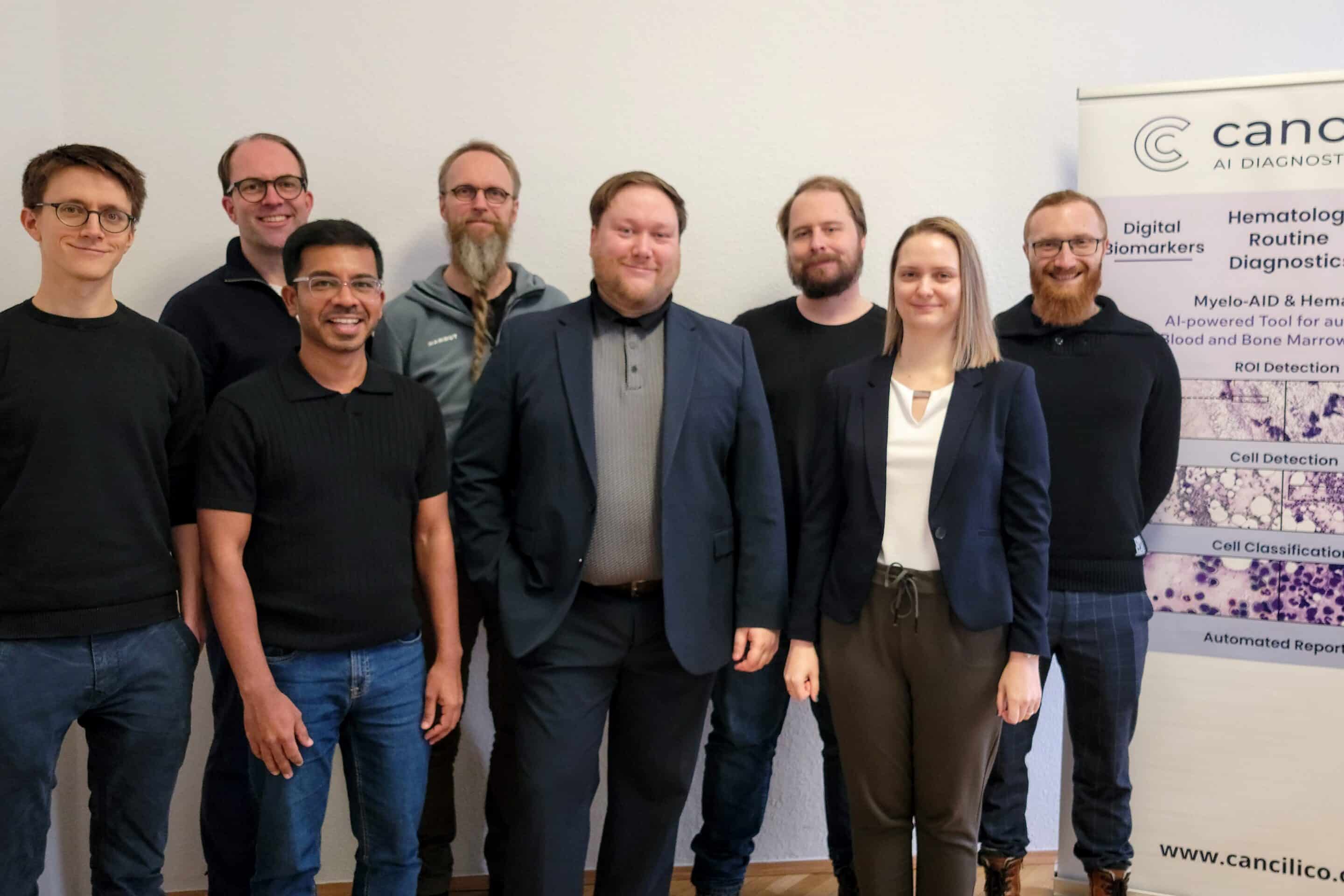
Cancilico Team
Using AI to fight cancer – Cancilico’s diagnostic software delivers fast and accurate results
TGFS
26 March 2026
The harsh reality in figures: According to the latest data from the Robert Koch Institute, in 2022 alone a total of 5,619 women and 7,835 men in Germany were diagnosed with ‘leukaemia’, commonly known as blood cancer. Their survival rate averaged 58 per cent. The good news is that modern technology can now significantly improve the chances of a cure. Early diagnosis and the selection of appropriate treatment methods are crucial to this. The Cancilico GmbH , based in Dresden has set out to make precisely that possible. This spin-off from Dresden University Hospital has developed AI-powered software that can detect blood cancer in bone marrow samples – many times faster and more accurately than humans have been able to achieve so far. Furthermore, by identifying biomarkers, personalised treatment plans can be devised that offer particularly high prospects of success for the patient. To roll out this advanced diagnostic software in medical laboratories worldwide, Cancilico recently completed its first major funding round, raising 2.5 million euros. Among the investors: the TGFS Technology Start-up Fund Saxony, which joined a renowned, supra-regional consortium. Alongside the TGFS, the High-Tech Start-up Fund (HTGF), GEDAD GmbH (the Ehninger family’s investment vehicle) and ROI Verwaltungsgesellschaft (Roland Oetker) also invested in the promising biotechnology company from Dresden.
Cancilico already boasts a number of high-profile beta customers. MyeloAID, as the software solution is called, is already approved for ‘Research Use Only’ (RUO) and is being used by medical institutions and pharmaceutical manufacturers throughout Germany for research purposes. As a next step, Cancilico aims to obtain ISO 13485 certification so that it can make the software available to an even wider user base. Markus Badstübner, co-founder and CEO of Cancilico, explains: “Our aim is to establish MyeloAID as a routine tool for the diagnosis of blood cancer both at home and abroad. The final decision still rests with the human clinician. Our mission is to empower medical professionals in their day-to-day laboratory work to reach faster, more reliable diagnoses and to contribute to better patient care.” Cancilico intends to use the newly raised capital to drive forward the certification process and recruit additional sales staff. Cancilico had previously received initial financial support from Prof. (emeritus) Dr Gerhard Ehninger. The former head of the Department of Haematology and Oncology at Dresden University Hospital is regarded as a leading authority in his field and has supported Cancilico as an early-stage private investor. In addition, the company, founded in 2023, succeeded in securing research funding from the Sächsische Aufbaubank (SAB).
With this investment from the TGFS Technology Start-up Fund Saxony, Cancilico is once again receiving financial support from Saxony’s innovation ecosystem. The funding was facilitated by Oliver Latz, Head of the ‘Life Science’ investment division at Mittelständische Beteiligungsgesellschaft Sachsen (MBG). He explains: “Cancilico tackles a structural problem in modern haematology: the sharp rise in the number of complex diagnostic cases, coupled with limited staffing resources. The interdisciplinary team combines in-depth clinical know-how with data science expertise and, with MyeloAID, is developing AI-based diagnostic software that has the potential to make image-based cancer diagnostics more efficient than ever before. With our investment, we are supporting Cancilico in further advancing clinical validation and bringing the technology into widespread use.” The efficiency gains are particularly significant, not least because conventional blood cancer testing is a manual and time-consuming process. Until now, every bone marrow sample has had to be analysed individually by experts under a microscope. The rising number and complexity of cases are being countered by a growing shortage of haematology specialists. MyeloAID resolves this discrepancy: thanks to intelligent AI algorithms, cancer cells can be automatically detected, counted and classified. Within a matter of seconds, clinicians receive a detailed analysis.
The AI was trained using data from Dresden University Hospital, which included not only data from patients with the condition but also samples from healthy donors. Published findings were also taken into account. The AI is continuously learning from user feedback and new data from partner laboratories. In the Free State of Saxony, Cancilico found a strong network of partners right from the start to develop its diagnostic software to market readiness and roll it out for clinical use beyond the state’s borders. In this context, the EKFZ for Digital Health is particularly worth mentioning, as it provided the infrastructure for the research work. The Saxon precision therapy cluster SaxoCell and the SEMECO future cluster also played a key role, through their networks, in ensuring that MyeloAID is now on the verge of a wide-scale market launch. Meanwhile, the Cancilico team is constantly working to further improve the usability and results of its software. In addition to sales, the product development team is also set to be expanded. The company’s headquarters in Dresden is a real ‘location advantage’, according to Dr Jan Moritz Middeke, co-founder and Chief Medical Officer of Cancilico. “Dresden University of Technology gives us access to highly qualified specialists. At Cancilico, they have the opportunity to play an active role in shaping the company’s growth and one of the most promising markets in medical technology.” And what job could be more meaningful for a person than helping to combat the widespread disease that is cancer?
TGFS deal team
Marie Habets & Oliver Latz
The article was published by the MBG Sachsen - management partner in TGFS.
Bildquelle: Cancilico

 English
 German